
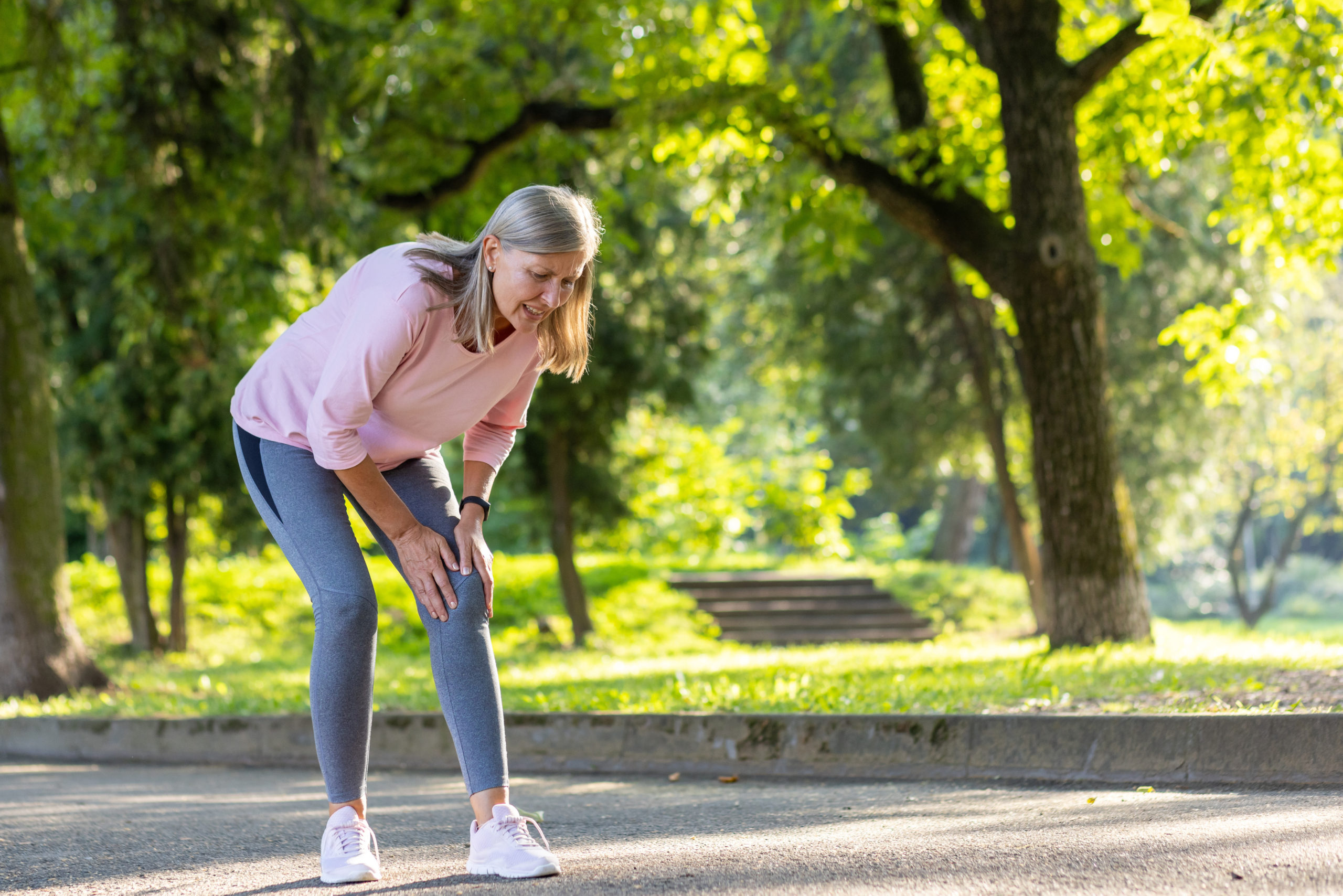
Knee pain! We have all heard someone complaining about it. But what is it?
Knee pain can arise from a multitude of reasons or medical conditions. Different conditions will have varying symptoms. Knee pain is also one of the main reasons people stop participating in sports and doing the activities they love. So, want to know more about how to tackle knee pain? Then let’s go through some common conditions that cause knee pain and how physiotherapy can help.
One of the main causes of knee pain, osteoarthritis is a common condition that mainly affects people over the age of 45. Degenerative changes are common as we age and this can cause symptoms such as;
- Pain
- Morning stiffness lasting less than 30 mins
- Crepitus / loud cracks and pops
- Knee locking or reduced range of motion
- Difficulty walking, going up or down stairs and/or performing general daily activities
Osteoarthritis affects nearly 6% of all adults with women being more at risk than men. Around 13% of women and 10% of men who are 60 years of age or older have symptomatic knee osteoarthritis. However, there is a large group of people who have knee osteoarthritis who experience little to no symptoms at all.
So how can physio help? Once your physiotherapist has assessed you for your osteoarthritis, we will usually begin with some education around the condition itself, as well as explaining why you are experiencing your symptoms. After, we may trial some hands-on treatment such as massage and joint mobilisations to provide some short-term pain relief to keep you moving and feeling good. More importantly we will work with you to find specific exercises to reduce your pain and improve your function for day to day. Exercises have been shown in numerous studies to be a safe and effective way of improving strength and reducing pain in those with knee osteoarthritis.
If your knee osteoarthritis does not continue to improve with physiotherapy and your knee ends up being too painful and keeping you up at night, your range of motion and function is significantly reduced, and you are unable to do the activities that you enjoy, it may be suggested to have a surgical opinion for a total knee replacement. If this is the route that you take, your physiotherapist can assist with some exercises before your surgery as well as working with you afterwards to restore full function of your knee.
PFPS is an umbrella term for pain that is originating from the joint between our kneecap and thigh bone. This is another very common condition that causes pain around the knee. Rather than degenerative changes occurring at the knee, PFPS has a multifactorial aetiology. Causes usually include muscle imbalances and weakness, overuse or overload of the joint itself, and possibly anatomical abnormalities. To put it simply, it is the result of poor biomechanical loading to the front of the knee that gradually builds up over time. Symptoms can include:
PFPS is more commonly seen in younger females but also adolescents and elite athletes. Looking at the general population, PFPS affects up to 29% of females and 15% of males.
During your physiotherapy session, you will be taken through an extensive examination to determine what impairments / factors may be contributing to your PFPS. After assessment, your physiotherapist can run you through pain management techniques, loading and activity recommendations, as well as a tailored exercise program that is focussed on the findings in your assessment. The prognosis of PFPS is favourable but 40% of patients continue to have ongoing symptoms past 1 year. The main aim of physiotherapy is to slowly build up your capacity around your knee joint to tolerate more load and get you back to enjoying your hobbies with reduced or no pain.
The meniscus is an important structure act as shock absorbers that cushion our knee joint. They also have a role in stability and weight distribution. We have two in each knee. One on the outer side and inner side of our knee. There are two types of meniscus injuries. One being traumatic while the other is degenerative.
Traumatic meniscal tears are often seen in athletes playing sport. The common mechanism for a traumatic meniscal tear is the knee in a flexed position; the foot is planted and then there is a quick twisting motion that occurs at the knee. These traumatic meniscus injuries can also occur alongside ligamentous injuries although still possible to happen in isolation as well.
Pain is the primary symptom athlete feel after injuring their meniscus. Commonly the injured person will have difficulty trying the straighten, bend or just generally move the knee. Depending on the severity and size of tear of meniscus injury some symptoms will include;
- Swelling
- Catching and locking
- Pain on movement
- Audible popping or clicking
For degenerative meniscus tears, there will often be no history of trauma or a mechanism of injury but rather a gradual onset of the symptoms above. Their symptoms will be usually worsened by squatting and kneeling.
An interprofessional approach between physio, GP and surgeon is used to address. If deemed appropriate, surgical intervention may be required to restore full range of motion to your knee by either removing part of the tear or repairing it. After surgery, your physiotherapist will guide you through exercises as well as some hands-on treatment to return you back to full function. If upon review, non-operative management is favourable, a physiotherapist will work with you to manage your symptoms through exercise to allow you to return to the activities you enjoy.
Does any of this sound familiar? Consider booking into physio so we can help get you back to doing the fun stuff.
References:
Neal, B. S., Bolgla, L. A., Lack, S. D., Bazett-Jones, D. M., Boling, M., Cowan, S. M., Eckenrode, B. J., Farraj, M., Kim, S., van Leeuwen, G. J., van Paassen, R., Potier, C., Riel, H., Roper, J., Yoon, C., van Middelkoop, M., & Collins, N. J. (2025). Prognosis of Patellofemoral Pain: A Systematic Review With Evidence- and Gap-Map. Journal of Orthopaedic & Sports Physical Therapy, 55(10), 661-670. https://doi.org/10.2519/jospt.2025.13491
Neal, B. S., Lack, S. D., Bartholomew, C., & Morrissey, D. (2024). Best practice guide for patellofemoral pain based on synthesis of a systematic review, the patient voice and expert clinical reasoning. British Journal of Sports Medicine, 58(24), 1486. https://doi.org/10.1136/bjsports-2024-108110
Petersen, W., Ellermann, A., Gösele-Koppenburg, A., Best, R., Rembitzki, I. V., Brüggemann, G. P., & Liebau, C. (2014). Patellofemoral pain syndrome. Knee Surg Sports Traumatol Arthrosc, 22(10), 2264-2274. https://doi.org/10.1007/s00167-013-2759-6
Poulsen, M. R., & Johnson, D. L. (2011). Meniscal injuries in the young, athletically active patient. Phys Sportsmed, 39(1), 123-130. https://doi.org/10.3810/psm.2011.02.1870
Raposo, F., Ramos, M., & Lúcia Cruz, A. (2021). Effects of exercise on knee osteoarthritis: A systematic review. Musculoskeletal Care, 19(4), 399-435. https://doi.org/10.1002/msc.1538
Smith, B. E., Selfe, J., Thacker, D., Hendrick, P., Bateman, M., Moffatt, F., Rathleff, M. S., Smith, T. O., & Logan, P. (2018). Incidence and prevalence of patellofemoral pain: A systematic review and meta-analysis. PLoS One, 13(1), e0190892. https://doi.org/10.1371/journal.pone.0190892
Yan, L., Li, D., Xing, D., Fan, Z., Du, G., Jiu, J., Li, X., Estill, J., Wang, Q., Belal, A. A., Tian, C., Li, J. J., Li, S., Liu, H., Liu, X., Ren, Y., Yang, Y., Chen, J., Hu, Y.,…Wang, B. (2025). Comparative efficacy and safety of exercise modalities in knee osteoarthritis: systematic review and network meta-analysis. Bmj, 391, e085242. https://doi.org/10.1136/bmj-2025-085242


