
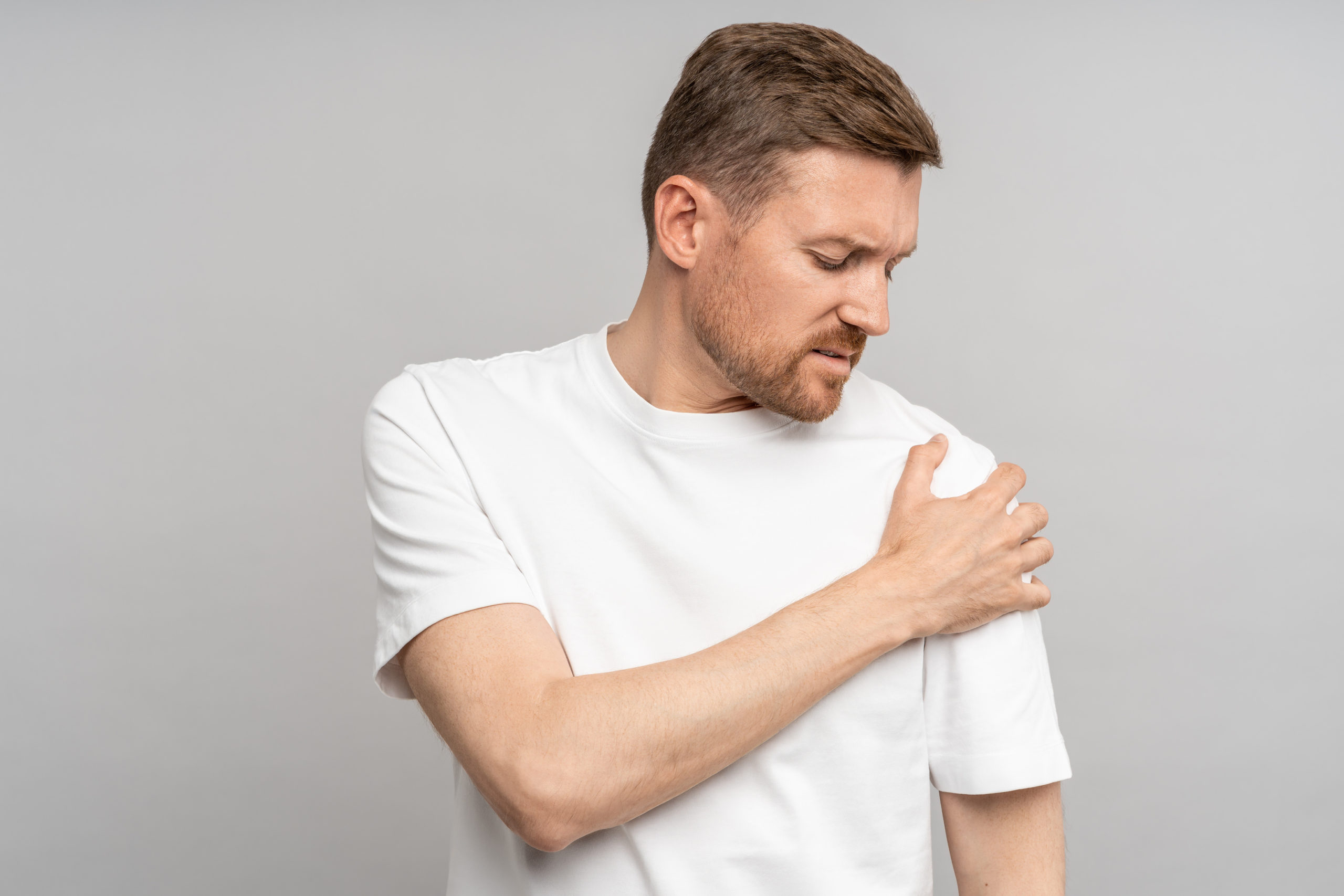
Shoulder pain is the third most common musculoskeletal condition seen by clinicians and can affect everyone from dog walkers and gardeners, to elite, junior and recreational athletes. There are multiple causes of shoulder pain which can either be brought on by traumatic events or have unexpected onsets of pain that don’t seem to be explainable.
Whilst shoulder pain is as common as it is, only 50% of people referred for management of shoulder pain completely recover from their first episodes of pain within 6 months. This can affect us each day with regular tasks or impact our ability to train, compete or play sports to the level we expect of ourselves, therefore impacting our enjoyment of the activities we love.
The shoulder (Glenohumeral) joint is where the humerus and scapula combine to create a ball and socket joint. As a ball and socket joint, the shoulder is an extremely mobile joint that allows us to move through a wide range of motion in order to do activities of daily living and exercise. To help improve the stability of this joint, the shoulder has a labrum which deepens the socket and provides structure and support. The rotator cuff muscles are some of the most important when it comes to healthy shoulder function, attaching from the scapular to the humerus and helping us lift our arm and rotate our shoulder aiding us in tasks such as dressing ourselves, swimming and playing sports such as golf and tennis. These include supraspinatus, infraspinatus, subscapularis and teres minor. Whilst these muscles are incredibly important for the shoulder to function, they can often get injured and will lead to;
Rotator cuff related shoulder pain (RCRSP) is an umbrella term used to describe a spectrum of shoulder conditions including rotator cuff tendinopathy, symptomatic tears to the rotator cuff and subacromial impingement.
Rotator cuff injuries can be caused by either traumatic or atraumatic mechanism. In cases of traumatic RCRSP episodes, this can be caused by activities such as dogs pulling on a lead, reaching into the back of a car to more high energy mechanisms such as high energy throwing or landing on the injured side. In atraumatic injuries, this is often caused by gradual overload of the shoulder through repeated activities such as repetitive golf or gardening activities for example leading to symptoms of pain when lifting the arm, particularly to the side of the body above shoulder height, pain reaching behind the back and when sleeping depending on position.
Due to their high ranges of range of motion, shoulders can dislocate in multiple directions, most commonly anteriorly. This is the most common large joint dislocation and makes up 96% of all shoulder dislocations.
Less commonly people can experience a posterior shoulder dislocation which accounts for approximately 4% of dislocations. It is often caused by a direct anterior force to the shoulder or seizures.
A physiotherapist role in shoulder dislocations extends from potential early diagnosis at the time of the injury if present on a sporting field and to later involving progressing patients through rehabilitation with particular focus on improving stability and reducing risk of recurrence of dislocations to therefore aid people in continuing to complete their activities of choice.
An acromioclavicular (AC) joint injury, often caused by a direct blow to the sop of the shoulder either from a fall or a forceful collision, is an injury to the acromioclavicular ligament or coracoclavicular ligament which connect parts of the clavicle (collarbone) to the scapular. Generally after such mechanisms the tip of the shoulder will be painful to touch, people may have pain with shoulder movements including raising arms above shoulder height or across body, swelling may be present and depending on the severity of the injury, there may be a visible lump where the joint has been disrupted which is called a step deformity. Grading of severity of AC joint injuries vary from:
X-ray’s can be useful in the grading of injury severity for AC Joint injuries and can help guide management.
As mentioned when discussing AC joint injuries, imaging including X-ray, ultrasound and MRI can be useful whilst not always necessary for initial diagnosis of shoulder injuries. In cases of shoulder dislocations, MRI’s can be useful after the fact to assess any associated injuries with the traumatic mechanism. For rotator cuff related shoulder pain, if imaging is initially to take place, it is likely that an ultrasound will be done, however is not always necessary for physiotherapy management.
Physiotherapy is often the first point of management for shoulder pain aiding in early diagnosis, intervention and education to manage the provocative symptoms of shoulder pain. This may involve things such as hands on treatment of soft tissue massage, dry needling and joint mobilisations to help reduce symptoms of pain and movement to allow people to more effectively complete the exercises which will improve the overall capacity of the shoulder and allow for continued participation in activities of daily living, hobbies, work related tasks and sport. Education for shoulder pain may relate to modifications to daily tasks and sleep including, not sleeping on the painful side or sleeping with the injured arm supported. Physiotherapists will help to navigate timelines for the injury working closely with their patients to create goals around appropriate interventions at different stages of rehab all the way to the end to help them return to doing what they love.
Dala-Ali B, Penna M, McConnell J, et alManagement of acute anterior shoulder dislocationBritish Journal of Sports Medicine 2014;48:1209-1215.
Ryan J, Whitten MBilateral locked posterior shoulder dislocation in a footballer.British Journal of Sports Medicine 1997;31:74-75.
Klintberg, Ingrid Hultenheim, et al. "Consensus for physiotherapy for shoulder pain." International orthopaedics 39.4 (2015): 715-720.
Chester, Rachel, et al. "Predicting response to physiotherapy treatment for musculoskeletal shoulder pain: a systematic review." BMC musculoskeletal disorders 14.1 (2013): 203.
Murphy, Richard J., and Andrew J. Carr. "Shoulder pain." BMJ clinical evidence 2010 (2010): 1107.
Verweij, Lukas PE, et al. "Assessment and management of shoulder dislocation." bmj 371 (2020).
Kavaja, Lauri, et al. "Treatment after traumatic shoulder dislocation: a systematic review with a network meta-analysis." British journal of sports medicine 52.23 (2018): 1498-1506.
Davy, Anthea R., and Steve J. Drew. "Management of shoulder dislocation—are we doing enough to reduce the risk of recurrence?." Injury 33.9 (2002): 775-779.
LeVasseur, Matthew R., et al. "Acromioclavicular joint injuries: effective rehabilitation." Open access journal of sports medicine (2021): 73-85.
Stucken, Charlton, and Steven B. Cohen. "Management of acromioclavicular joint injuries." Orthopedic Clinics 46.1 (2015): 57-66.
Lindborg, Carter M., et al. "Current concepts in management of acromioclavicular joint injury." Journal of Clinical Medicine 13.5 (2024): 1413.


