
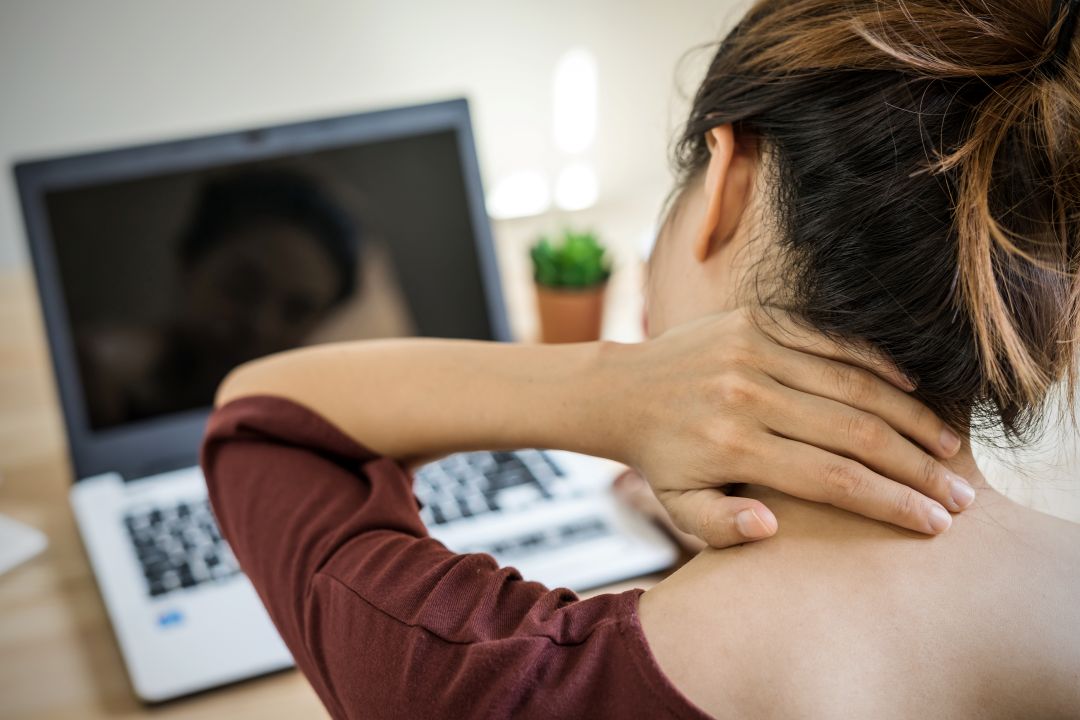
Neck pain is a common condition that will affect roughly half of all people in their lifetime (Cohen, 2015). It is one of the five most prevalent causes of disability worldwide, and the second most common musculoskeletal pain after lower back pain (Cohen & Hooten, 2017; Tiechert et al., 2023).
Most cases of acute neck pain will self-resolve within 2 months, however about 50% of people will have a repeat episode within 1 year (Cohen, 2015).
The majority of neck pain is defined as non-specific as it occurs without a clear cause and cannot be attributed to a specific structure. In most cases, neck pain will self-resolve with or without treatment, however treatment can assist with managing pain in the short term and potentially speed up recovery. Red flags are signs that a more serious issue may be occurring and must be excluded by a trained medical practitioner. The most common red flags are changes in sensation and weakness down the arm (see Red Flags below). A physiotherapist can perform a thorough assessment to determine the cause of your neck pain and provide treatment to reduce pain in the short term and reduce the likelihood of a recurrent episode in the long term.
The neck is a very complicated region, containing more than 20 pairs of muscles, and important structures including the cervical spine, facet joints, nerves and blood vessels (Qu et al., 2022). Broadly, neck pain can be split into two groups: specific neck pain where a clear structure can be identified as the cause, and non-specific neck pain. Most cases are classified as non-specific as it is often impossible to determine which specific structure is causing pain (Qu et al., 2022).
Risk factors that increase the likelihood of experiencing neck pain include:
Female sex, middle age, smoking, workplace and occupational factors including low job satisfaction, poor perceived workplace environment, duration of daily computer use and perceived job demands. Psychosocial factors including anxiety, depression, stress and poor coping skills. (Cohen, 2015; Qu et al., 2022; Kazeminasab et al., 2022)
In the case of trauma causing neck pain (car crash, sporting accident, hitting your head etc.), it is crucial to clear all red flags to ensure you are safe (see Red Flags below).
Due to the complex nature of neck pain, it is often subcategorised into three groups:
Mechanical: Related to a physical structure such as muscle, facet joint or disc. Symptoms often include localised pain described as throbbing or aching.
Neuropathic: Nerve pain caused by mechanical or chemical irritation, such as a herniated disc pushing on a nerve root, nearby inflammation aggravating a nerve, or spinal stenosis compressing a nerve root. Pain is described as shooting, burning, zapping or electrical, and will commonly radiate into the arm.
Mixed: A combination of mechanical and neuropathic. For example, an inflamed spinal disc causes mechanical pain, and the inflammation irritates the nearby nerve root causing neuropathic pain as well.
(Cohen, 2015; Cohen & Hooten, 2017)
Purely neuropathic presentations are quite uncommon, with mechanical and mixed presentations accounting for roughly 43% and 50% of cases respectively (Cohen & Hooten, 2017).
Red flags are symptoms or signs that indicate a more serious or potentially life-threatening issue may be at play. If you are experiencing any of the following, seek medical guidance as soon as possible:
(Cohen & Hooten, 2017; Feller et al., 2024)
Imaging is not recommended in cases of neck pain unless red flags are present or there is sufficient clinical suspicion. There is no evidence that the presence of radiographic abnormalities impacts on the outcome of treatments (Cohen, 2015).
Note: Around 60% of people over the age of 40 who are pain free will show abnormalities on imaging. These are expected age-related changes and should be thought of as wrinkles on the inside rather than injuries.
Neck pain can be managed by a combination of stretching, strengthening and manual therapy. There is good evidence that basic strength and stretching exercises can provide both short and moderate term relief, and can also help reduce the likelihood of a recurrence (Cohen, 2015; Tiechert et al., 2023). Manual therapy can also be beneficial in the short term, however provides no long-term benefits or reductions in recurrence (Cohen, 2015).
Non-specific neck pain will typically self-resolve without treatment, however treatment can assist with pain management and potentially speed up recovery. The most effective interventions in the short term are manual therapies, exercise and k-taping (Castellini et al., 2022).
In the case of specific neck pain, outcomes can vary:
Cervical radiculopathy: The majority of patients will experience improvement with or without treatment, however timelines can vary (Cohen, 2015). Around 83% of people with cervical radiculopathy will recover in 1 to 2 years, with significant improvement occurring in the first 4 to 6 months (Thoomes et al., 2022; Cohen & Hooten, 2017). A physiotherapist can provide advice, identify beneficial movement, and in the case of no improvement, assist in identifying alternative treatment options.
Herniated disc: Herniated or bulging discs will commonly resorb, with most cases showing significant improvement in 6 months and full recovery in 2 to 3 years (Cohen & Hooten, 2017). It is important to avoid painful positions as these are commonly causing compression to the disc.
Cervical myelopathy: Unlike other causes, myelopathy will typically not self-resolve and will require treatment. In the case of deteriorating symptoms, surgery is often recommended (Cohen, 2015).
In any of these cases, a physiotherapist can properly assess your neck pain to determine potential causes. They can then perform hands-on treatment to reduce pain and increase function, and provide you with a tailored plan to address these causes long-term.
Alec completed a Bachelor of Science with a major in Therapy Studies at Flinders University before moving to Tasmania in 2022 to complete his Masters of Physiotherapy at the University of Tasmania in Launceston. Before studying physiotherapy he spent seven years working as a Remedial Massage Therapist, which gave him an unusually strong foundation in manual therapy and a practical, hands-on approach to treatment. Originally from Adelaide, he has quickly made Tasmania home and brings a focus on goal-setting and helping patients return to the activities that matter most to them.
Castellini, G., Pillastrini, P., Vanti, C., Bargeri, S., Giagio, S., Bordignon, E., Fasciani, F., Marzioni, F., Innocenti, T., Chiarotto, A., Gianola, S., & Bertozzi, L. (2022). Some conservative interventions are more effective than others for people with chronic non-specific neck pain: a systematic review and network meta-analysis. Journal of Physiotherapy, 68(4), 244-254.
Cohen, S. (2015). Epidemiology, diagnosis, and treatment of neck pain. Mayo Foundation for Medical Education and Research.
Cohen, S., & Hooten, M. (2017). Advances in the diagnosis and management of neck pain. BMJ, 2017(1).
Feller, D., Chiarotto, A., Koes, B., Maselli, F., & Mourad, F. (2024). Red flags for potential serious pathologies in people with neck pain: a systematic review of clinical practice guidelines. Archives of Physiotherapy, 14(105).
Kazeminasab, S., Nejadghaderi, S. A., Amiri, P., Pourfathi, H., Araj-Khodaei, M., Sullman, M. J. M., Kolahi, A., & Safiri, S. (2022). Neck pain: global epidemiology, trends and risk factors. BMC Musculoskeletal Disorders, 23(26).
Qu, N., Tian, H., De Martino, E., & Zhang, B. (2022). Neck pain: do we know enough about the sensorimotor control system? Frontiers in Computational Neuroscience, 16(2022).
Thoomes, E., Graaf, M. T., Cleland, J. A., Gallina, A. & Falla, D. (2022). Timing of evidence-based nonsurgical interventions as part of multimodal treatment guidelines for the management of cervical radiculopathy: a Delphi study. Physical Therapy, 105(5).
Tiechert, F., Karner, V., Doding, R., Saueressig, T., Owen, P. J., & Belavy, D. L. (2023). Effectiveness of exercise interventions for preventing neck pain: a systematic review with meta-analysis of randomised controlled trials. Journal of Orthopaedic and Sports Physical Therapy, 53(10), 594-609.


